New tyres in a corona-world: virtual Tyre Industry Conference
The wide-ranging 45-minute conver-sation covered a lot of bases, but the first session, which was designed to focus on the new tyre market's recent trends and statistics began with a presentation from James Ward.
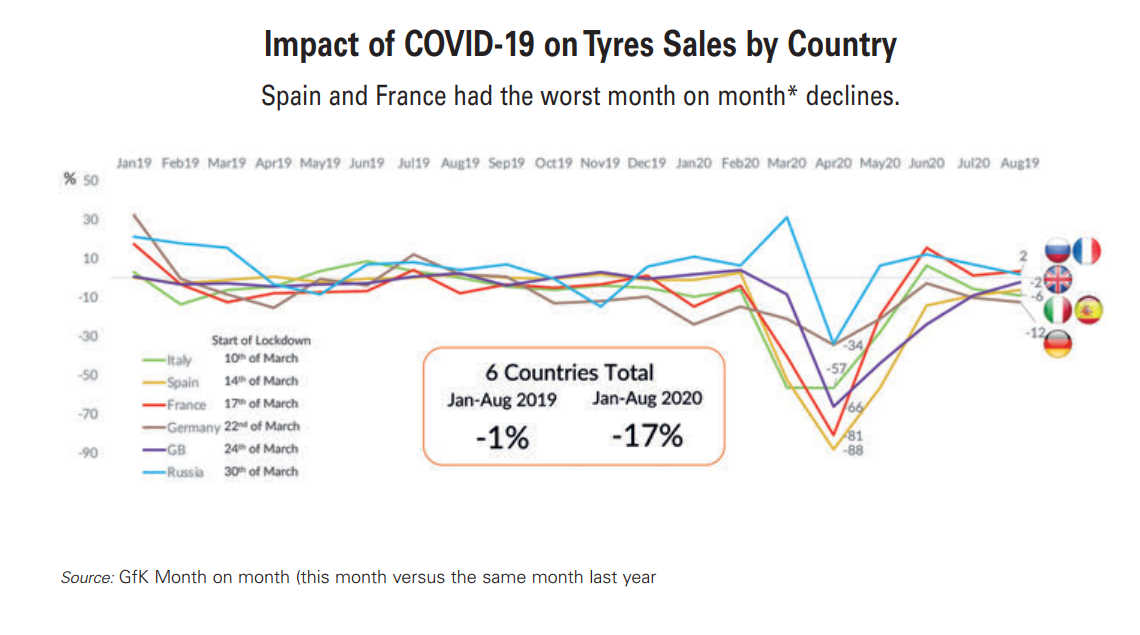
Beginning with some global context,this session's market overview highlighted how the different continents had been affected by the pandemic. In short, the impact of Covid-19 was milder in North America (down 8 per cent in terms of tyresell-out volume) and Eastern Europe(down 3 per cent). At the other end of the spectrum, South America came off worst, with tyre sell-out volumes down 21 per cent; followed by Europe (down 20 per cent in terms of tyre volumes). However, it is worth highlighting that earlier in 2020 during the course of the first lockdown, respected voices including premium manufacturers were projecting market contractions of 26 per cent this year. Therefore, despite the Western European results being amongst the worst in the world, they were actually better than expected.
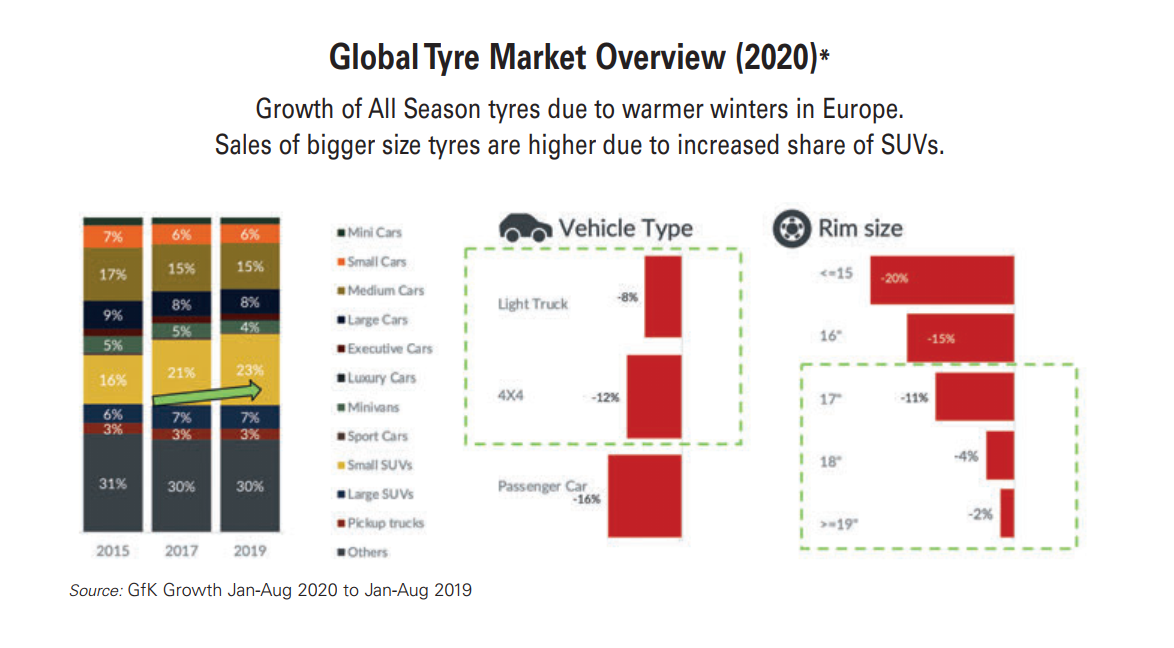
Zooming in on the Western European market, James Ward explained how consumer buying habits changed between January and August 2020 in comparison with January to August 2019. In short, the changes represent much more exaggerated versions of the trends we have long seen in the market. For example, demand for less than 15-inch tyres contracted 20 percent, but greater 19-inch demand was down just 2 percent. In other words, the18 percentage point gap between the top and the bottom of the market in terms of growth is similar to what it might have been if the sector as a whole was in positive territory. Something similar is reflected in the vehicle type breakdown where standard passenger cars were far worse affected than 4x4s and light trucks. However, broadly speaking, recent seasonality trends held up in Europe. Broken down by season, summer tyre sales grew 0.5 per cent along with all-season tyres (up 2 per cent), while winter tyre sales were down 6 per cent.
Is there evidence of downsizing and de-segmentation?
Still, as positively as one might feel about the market, the fact that there are still challenges to face is exemplified by the GfK's GB Panelmarket data. Here, broken down by rim-size, everything is down between 15 and 18 per cent. Even the fastest growing greater than 17-inch segment was down 16 per cent and 15 percent in terms of value and volume respectively. In short, growth rates have been hit across the board, but there is no evidence of down-sizing in terms of rim diameter.
As we saw in global and European terms, ongoing trends have also continued in Great Britain, with the panelmarket split by vehicle type transitioning away from cars towards 4x4 and light-truck vehicles.
But what about segmentisation? Have tyre consumers traded down in terms of brand tier? Not exactly, the budget end of the market has increased its share by two percentage points from 42 per cent to 44 per cent of the panelmarket, but this was not at the cost of the premium brands as it was in the fallout from the financial crisis of 2009. Rather the mid-range continues to be the“squeezed middle", bearing all the brunt of the budget sector's growth.
All-season tyres are the big winner when you look at the data in terms of seasonality. Out-and-out winter tyres sales lost 18 per cent of their value and 20 per cent of their value. In another year the fact that all-season tyre sales were down 1 per cent by value and 5 per cent by volume is a reflection of the enduring medium-term growth of this segment. Describing the above trends, James Ward sales of both winter and all-season tyres would continue their current trends:“We expect winter [tyres] to continue as it is for the moment as well.”
Putting all this together, and further contextualising the data with the transport implications of the pandemic, Ward gave the following reasons for optimism and concern. Average vehicle age will increase: with new registrations at a low, drivers (both private and fleet) will keep their cars longer. Larger rim sizes will continue to gain market share due to historic SUV sales. All-season tyres will continue to gain in popularity across all-brand tiers. With many people having spent a large proportion of the year working from home and – at the time of the conference and of going to press – the entire UK in lockdown, consumers are looking to secure independent means of travel on the one hand, while also travelling less on the other. These changes in driver behaviour and commuting habits could well be permanent. The increasingly likely prospect of no-deal Brexit is a continuing concern for the tyre business because – apart from the logistic implications that come with the departure of frictionless boards – will mean taxes of 4.5 per cent on tyres from the continent of Europe. In addition to the direct impact of no-deal Brexit on tyre taxes, higher duty rates on the imports of other items such will also affect tyre retail. TVs for example will attract a 14.5 per cent tax rate and any price hikes on TVs will therefore affect the disposable income available to drivers when its tyre change time.
But no-one can deny the opportunities that growth in increase uptake of online tyre retail brings with it. At the same time, the rapid increase in general online retail brings with it increased demand for van tyres to service the delivery side of such businesses. So, when you put such trends together with the fact that – according to the most recent data at least – business has been less affected than we first expected, there are some reasons for optimism as 2020 draws to a close.